November 03, 2017

Experience in Vikurskoli


Tell me a story
Telling and writing stories is a big part of the training in languages, wheter it´s your native tounge or a second language.
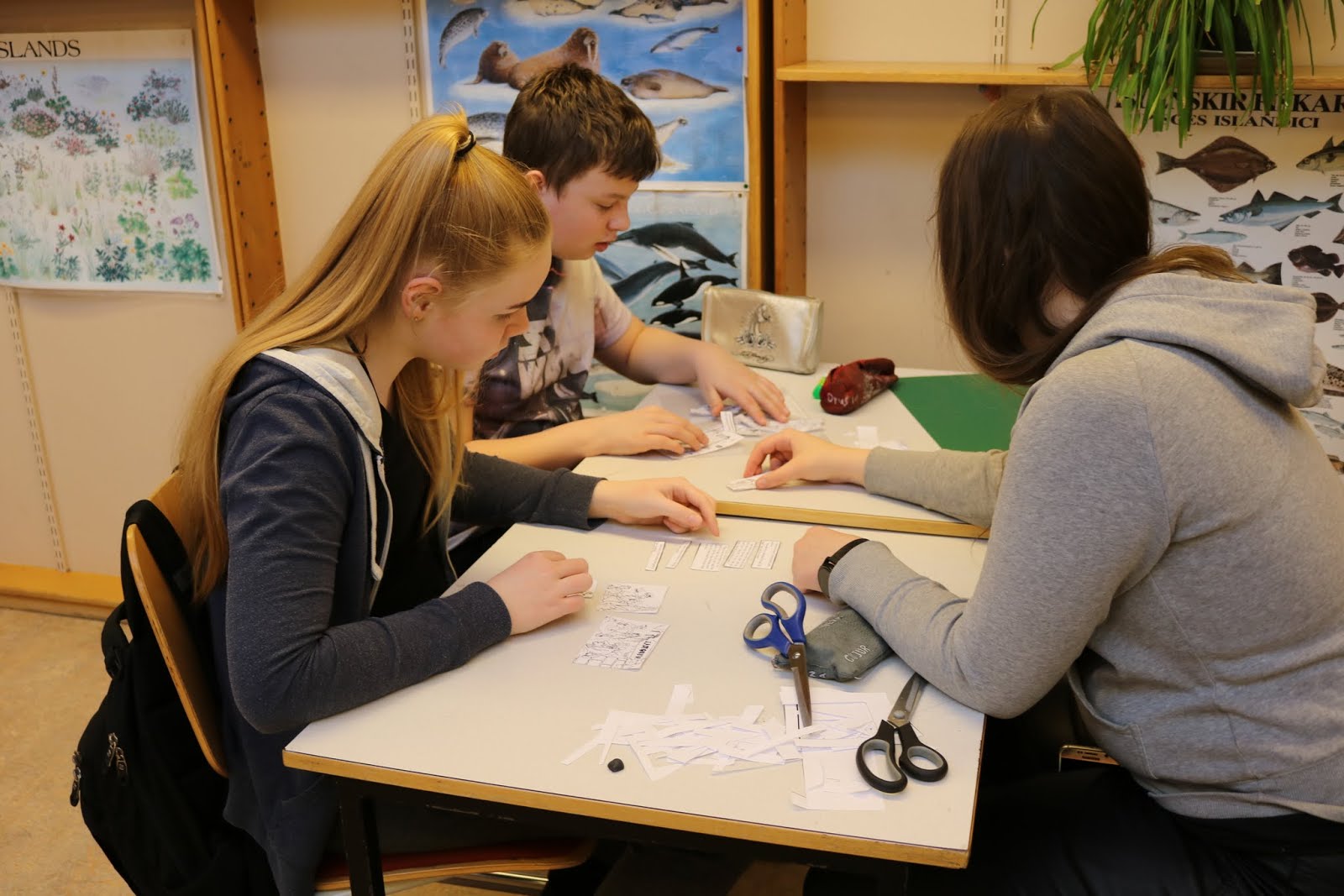
We decided to try the activity from Grand Canaria, where the students are given the task of paring images and texts of different difficulty to complete a story.The group was composed of 15 students age 15 – 16 , divided into four smaller groups, each group with a different story.

1.     Selecting the students into groups.
I wanted to have as varied groups as possible according to gender and ability, so I made sure there were students of both sexes in each group.
Since the number of students is low it was not possible to have mixed abilities in each group so I decided to have 2 groups with mixed abilities, 1 group with high achievers  and one group with students of an intermediate level in english.

2.     The activity.
Students followed each sequenced step of the activity, except for the last one, there was not time to do the powerpoint presentation, and the students thought it was actually more fun making posters.

3.     Results / findings.
It was quite interesting  to see how differently the groups performed this task. The two groups og mixed abilities did really well in their planning of the activity, delegating tasks, and getting started. In one of the group I  made the lowest acheiving student „the boss“, which turned out to work really well, he was firm with the others, delegating tasks, but still doing the best he could to finish the work.
 Also these two groups were the ones least reluctant to ask for help.

The high achiever´s group had a slow start. There were two boys and one girl. I originally appointed one of the boys to be „the boss“, but after a while I had to change and made the girl the group leader, which made all the difference. She is quite shy, but in this role she really shone. This group ended up doing a very nice presentation of their story.

The last group, with students hwo were all at the same intermediate level of knowlege and skill in english, had the most difficult time to finish the work. They found it difficult to delegate tasks, could not agree on the best way to do things and were on the whole rather negative towards the activity.I had to step in and direct their work quite a bit and help them a lot, although they did not ask for it.

After the students had finished their posters and presentations we had a discussion about why we did this activity.


RESPECT disscusion ideas (Iceland 3)


RESPECT disscusion ideas


October 01, 2017

Communication skills (German activity 2)


Author: Karin Zelenka, class teacher


School, country: Mittelschule Woerth

Level: lower secondary, age 10 to 15

Subject: Practical training

Title of the activity: Communication skills

Pupils work in teams of 4

First they get a situation/ task.
e.g.
1. Asking the secretary for a copy of a worksheet the person lost
Person 1 takes over the part of the secretary (who reacts differently according to the person talking to her)
Person 2 takes over the part of a naughty, impolite kid
Person 3 takes over the part of the polite kid
Person 4 watches the situation and supervises


First they plan the situation and think about the words they will use.
Then they act it and change roles.
After everybody had taken over every part the pupils talk about their feelings and try to find an appropriate behaviour and tone.
Then they play this improved version.


Further situations:
1.       Asking a classmate for a pen
2.       Asking the parents to go out and stay longer than usual
3.       Telling the teacher about the missing homework
4.       Telling the headmaster that you broke something of the school premises
5.       Asking for information at the help desk at the station/ airport

September 26, 2017

English lesson - word order (Act. # 5)


Author: Jaana Auer, special education class teacher

School, country: Helsingin Uusi yhteiskoulu, Finland

Level: lower secondary 8th grade, age 14

Subject: English

Title of the activity: Word order, sentences and questions


 Justification and description of the activity:

ENGLISH LESSON/ 8TH GRADE SPECIAL EDUCATION CLASS

We practised English grammar, sentence structures, sentences, questions and negative sentences. The test was due the following week and this grammar topic was quite challenging for most of my pupils.
I wrote the words WHO-DOES/DID (auxiliary)- WHAT-HOW- WHERE- WHEN (in Finnish) on a sheet of paper and attached them on the board. I had sentences in English cut into pieces and I shared the papers to my pupils, after which they had to put the English words under the right headlines. Then we read the sentences out loud and translated them into Finnish.
After that pupils made their own sentences with Funny Sentence cards (a picture below) and read those sentences to others.
In the test I used those same sentences as we had already practised and the test went actually quite well and the pupils were pleased about it :D


A game I bought from the Science Museum in London


BIOLOGY/ PLANT CELL ANATOMY/ 8 th grade (Finland activity #4)


Topic: BIOLOGY/ PLANT CELL ANATOMY
Learning by doing

Author: Jaana Auer, special education class teacher

School, country: Helsingin Uusi yhteiskoulu, Finland

Level: Lower secondary school, 8th grade, age 14, special education

Subject: Biology, 90-minute lesson

Title of the activity: Plant cell anatomy


In Biology we studied plant cell anatomy. First we read about plants, their structure and cells from the text book. I showed the students a clay model I had made before. A model picture of the plant cell was projected on the screen. Students made plant cell models by using modeling clay and Magnetix- parts. They built the cell on a paper plate and wrote the names of the parts of the plant cell on the paper plate.


A model picture of a plant cell


The clay model made by the teacher

Clay models made by students


 The students liked this activity a lot because they could learn by doing with their own hands.
 I gave the students a test on plants and cells the following lesson. They all did quite well!